

I recently came across a news story you really wouldn’t expect: a new species has been discovered in Ecuador. And I’m not talking about a giant animal or something straight out of fiction. It’s a new small shrub that grows on trees, found in the Cordillera del Cóndor mountain range in Zamora Chinchipe. They called it a botanical gem. And with good reason.
What’s most striking isn’t just the plant itself. It’s the context. In the year 2026, when it would seem that everything has already been documented, Ecuador continues to uncover species that science is only just beginning to describe. And this one appeared in one of those ecosystems that still hold far more than we can see from the outside.
The species that appeared when it seemed everything had already been seen
The plant is called Thibaudia shagmiana. The name is backed by a scientific publication, an international team of researchers, and a reference specimen deposited in the UTPL herbarium. That provides a foundation for the discovery. But the most interesting part emerges when one asks a fairly simple question: how is a new species still appearing now?
That’s where the news becomes even bigger. Because the discovery of a plant also speaks to a territory that remains difficult to fully understand.
A humid, isolated, and largely unexplored mountain forest, where there are still forms of life that are only just beginning to appear on the scientific map.
The Cordillera del Cóndor, a territory that continues to surprise science
The Cordillera del Cóndor has been appearing in botanical studies for years for a very clear reason: it possesses conditions that are almost unique in the country. These include sandstone plateaus, constant fog, humidity, moderate elevation, and soils so nutrient-poor that they force plants to adapt in very specific ways.
Where the forest changes its own rules
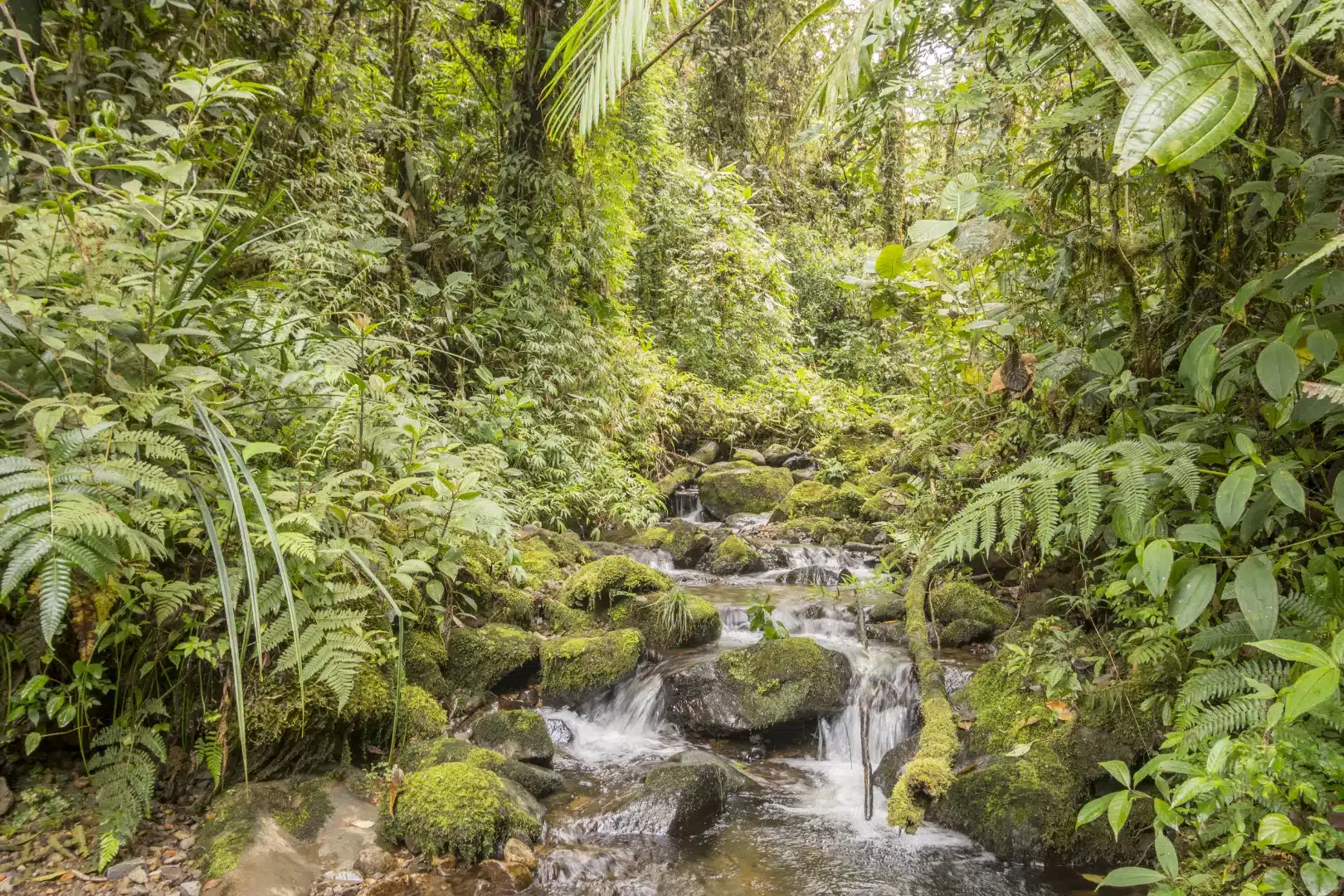
From a distance, one might think it’s just another mountain forest. But as you get closer, something else emerges: a series of highly restricted microhabitats, with plant communities that have evolved under quite harsh conditions.
That combination of isolation and environmental stress ultimately pushes life down unusual paths. That’s why species found in this mountain range are not found anywhere else.
Why new species keep appearing here
Therein lies one of the keys to the discovery. The Cordillera del Cóndor continues to surprise because it still preserves areas that are botanically unexplored. For science, this makes it a territory of immense value. Botanists, ecologists, and taxonomists arrive knowing that a field trip may end with a new question or, suddenly, with a species that no one had formally described.
The setting where this plant appeared
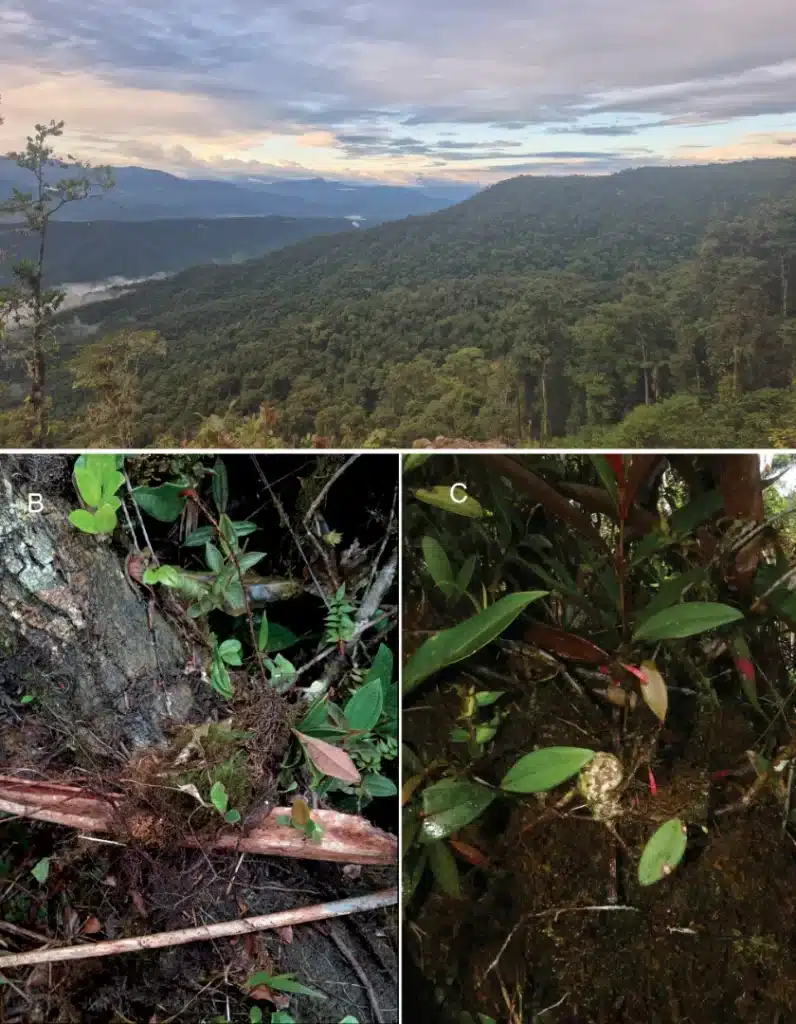
In this case, the location matters just as much as the species. The Shagmi Plateau, where Thibaudia shagmiana was found, meets precisely those conditions: frequent fog, low montane forest, sandstone, and a geography that makes access difficult. There, the forest operates by a different logic. Life organizes itself with tighter margins and much more precise adaptations. When that happens, discoveries cease to seem strange and begin to feel like part of what that territory has long been holding onto.
A botanical gem that almost no one had seen
The first thing that makes Thibaudia shagmiana seem strange is the way it lives. It does not grow by sinking roots into the ground, as one might imagine when thinking of a shrub. It lives on trunks and branches, clinging to trees, taking advantage of the forest’s constant humidity.
Flowers that catch the eye at first glance
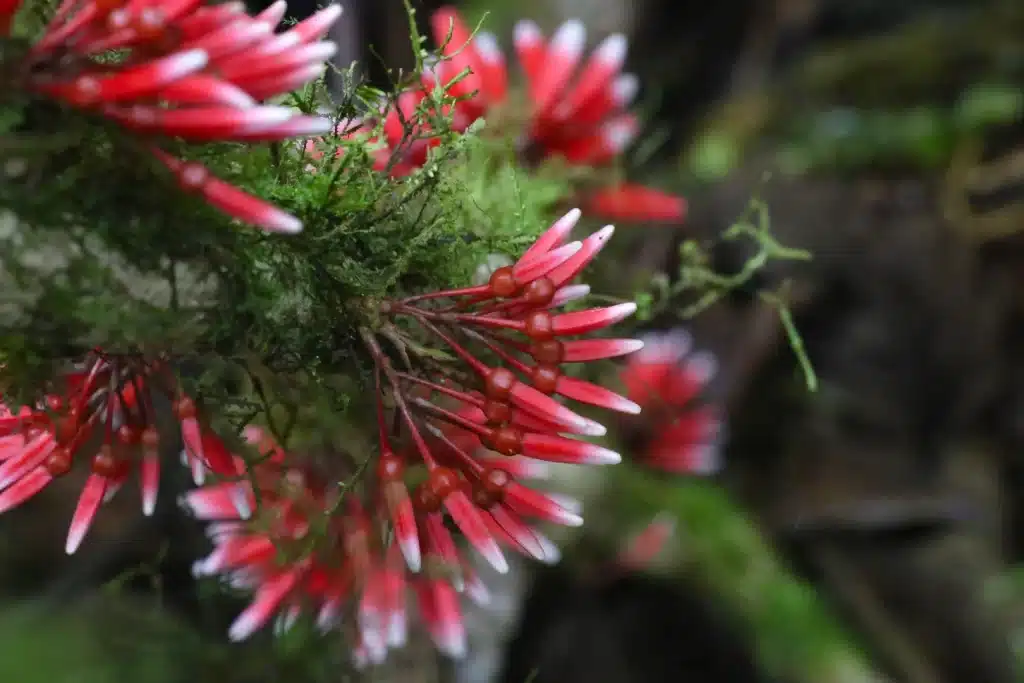
Then there are the flowers. Tubular, slightly pentagonal, ranging in color from magenta to scarlet.
They emerge alone or in small clusters directly from the branches. That image carries a lot of weight in the news because it explains why UTPL called it a botanical gem.
It truly stands out visually, with a shape and color that seem designed to make someone stop and take a closer look.
What science is beginning to learn from it
To me, this seems to be one of the most powerful aspects.
A newly described species does not yet come with all the answers. Rather, it comes loaded with questions.
Thibaudia shagmiana has lignotubercles, woody structures that store water and nutrients. Its leaves are thick, leathery, and clustered at the tips of the branches like small rosettes. All of this suggests a life finely tuned to environmental stress.
And that’s where the discovery becomes more than just a pretty flower.
For botanists, ecologists, and taxonomists, a plant like this isn’t just a new entry on a list. It’s a clue. It speaks of adaptation, of evolution, of relationships with the forest that are only just beginning to be understood. Does it grow on any tree or does it prefer certain ones? What pollinates it? How does it reproduce in such a restricted ecosystem? How dependent is it on that mist, that plateau, that type of forest? The news raises these questions, though it does not yet answer them.
Why it becomes extraordinary so quickly
With some species, uniqueness is evident due to size or fame. Here, something else is at play.
Thibaudia shagmiana becomes extraordinary because it combines many rarities at once:
- It lives in a very specific location.
- It has a specialized growth pattern.
- It displays striking botanical features.
- It appears in an ecosystem that continues to yield discoveries.
That is enough to make the discovery of interest to plant enthusiasts, to those who study evolution, and also to those who seek to understand how these still largely unexplored forests function.

Seven individuals and a threat that’s all too close
Here the tone of the news shifts. The species was described, yes, but at the same time it became clear that its range is minimal: so far, only seven individuals are known at the type locality. With a number like that, any pressure on the site no longer seems like a distant concern.
And that pressure exists. The habitat where Thibaudia shagmiana was found lies within an active mining concession.
That is the most critical point of the entire story: the plant was found in such a restricted location that any disturbance to the terrain, the forest that supports it, or the humidity conditionscan directly affect its survival.
That is why it was proposed as Critically Endangered. Not out of exaggeration. Because of scale. Because when a species lives in almost a single spot, the risk ceases to be theoretical.
What this news reveals about Ecuador
This news says a lot about the country.
On the one hand, it confirms something that continues to surprise: in Ecuador, new species are still being discovered.
On the other hand, it reveals a less comfortable aspect of that richness. Many of the country’s most unique life forms live in very small areas, depend on very specific conditions, and are exposed when those territories come into conflict with extractive activities.
That is the uncomfortable part of the discovery. Ecuador’s megadiversity continues to yield extraordinary news, but it also forces us to look more closely at where these species are, how much territory they occupy, and how well protected they actually are.
What science would lose if this species disappears
Here, the loss is no longer measured solely in terms of the number of individuals.
It is measured in knowledge. A newly described species still raises many questions: how it evolved, what its relationship is to other plants in the genus, how it reproduces, how dependent it is on certain trees, and what role it plays within that forest. All of this is just beginning.
So, if this plant were to disappear, we would not just lose a beautiful or rare species. An entire line of research would be lost before it even had a chance to develop. A botanical, ecological, and evolutionary door would close almost as soon as it was opened. And that is a much greater loss than it seems at first glance.
The question this discovery leaves hanging in the air
After reading all this, the plant ceases to be the sole focus of the story. The focus shifts to the forest. If a species like this could go unnoticed until now, then the question is no longer just what was discovered, but what else remains there unnamed, unstudied, and without sufficient protection.
That is the most powerful takeaway from the news. Not because I want to sound mysterious, but because it raises a big question:
How many species might still be hidden in small ecosystems?